The new generation of search engine architecture is changing with the aim of searching from keywords in artificial intelligence-supported search systems. So search intention optimizations for visibility in the digital ecosystem are among the most important steps of AI SEO.

Classic SEO strategies have always targeted keywords for many years. SEO success of a web page has been evaluated with criteria as it has been in the header and meta tags, how many times the targeted word goes on the content. Yet now integrated into the search engine architecture of artificial intelligence, making such strategies meaningless. Because search engine algorithms and AI agents are looking at how compatible with the context of the page, not how many times the words on the page. This makes it mandatory for a brand new knowledge architecture in AI SEO with a transition from keywords to search intention.
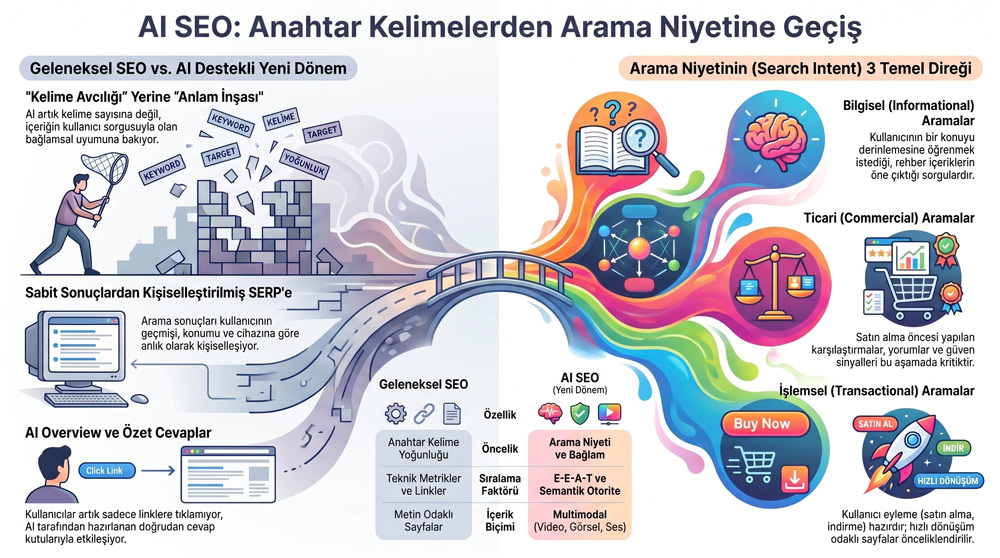
Being integrated in the search engine architecture of artificial intelligence, the key word-oriented classic SEO strategies have no longer been insufficient. In particular, Google’s BERT, MUM, Gemini, and finally the improvements provided with AI Mode are transformed into the model of "anlam build" that is believed to be "kelime hunter". So SEO Service and now keywords in AI-oriented content strategies are not in the center. Instead of the user’s search purpose is much more important. That’s, the most appropriate, symmagnetic structure is strong, AI readability high content of the new era is to be the most successful content.
Data collection methods of smart search algorithms have become one of the most important parts of this conversion. Because AI-supported systems are no longer only scanned text on their web pages. It analyzes multi-layer data such as user behaviors, navigation habits, device types, semantic relationships. It turns into a new structure based on behavioral and meaningful analysis. That’s why it’s not just a SEO change in fact that you’re going to call from keywords. This transition actually refers to the whole change of search engines to understand and interpretation.
AI Central Exchanges in Search Engines
Search engines have worked as systems that match word between queries and content for many years. However, the situation has changed with integrated the search infrastructures of artificial intelligence. Nowadays search engines can not only sort content based on keyword density. Instead of contextual meaning, user behavior, semantic relationship network and various analyses based on search intention. Depending on these analyses, rankings vary every time.
Thanks to the semantic indexing with natural language processing (NLP) and machine learning, search engines now analyze what users write, what they really want to learn. Moreover, even if the phrases are missing, complicated or incorrect, AI-supported systems understand the main purpose behind the query. So the classic "word-based search" model replaces the "protection and context-based search" model. This situation, SEO Rank as well as important changes occur.
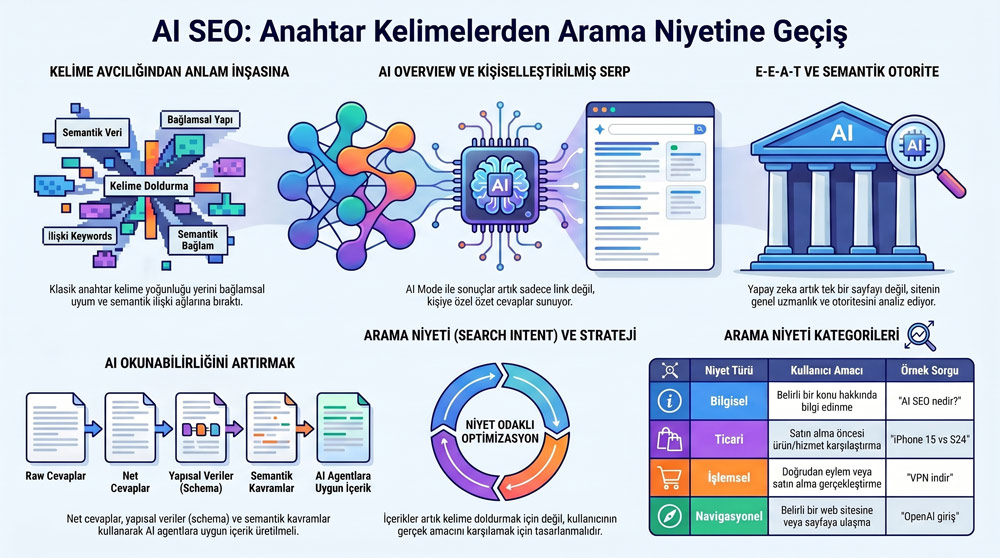
With the activation of Google AI Mode in Turkey, users don’t see link lists anymore on results pages. AI Overview outlines meet recommended response blocks, entity-based information panels, speaking-like responses and personalized results. This change is not only to search engines of content producers, but also to make it mandatory for AI agents, answer engines, and to produce appropriate content to semantic data systems. Passing the intention to search from keywords in this context, to increase the importance of AI SEO strategies.
So, wonder what are the basic principles of AI-based search technologies? To express briefly, the basic principles of AI-based search technologies are based on the evaluation of contextual meaning, search intention analysis, semantic relationship network and user behaviour data together. AI-supported search engines create ranking by analyzing content entities in terms of relationships, E-E-A-T signals and symmagnetic structure. Thus, the classic search experience is replaced by a personalized, context-oriented and multi-layered information access system.
Basic Changes That Ages in AI Supported Search Systems
- Artificial intelligence-supported algorithms analyze user behavior more detailed. The time spent on the page, the interaction rates are now more effective in ranking signals.
- Search results now carry a much more personal attribute than the former. User’s history calls, location, interests and other metrics results directly affect.
- Traditional "10 blue connection" model replaces a more interactive SERP structure. Google AI Mode Switch Home With the results pages, information panels, AI response boxes, video blocks and other features stand out.
- AI Overview and similar systems offer summary answers without clicking on the link to the user. This situation significantly changes classic organic traffic dynamics.
- Increased queries with voice search and speaking language, making natural language optimization more critical. That’s why it’s important to stand out that content is close to the speaking language.
- Entity-based indexing systems analyze human, brand, location and concept relations with high precision. Therefore, semantic connections and structural data are much more important than the former.
- AI systems analyze not only a single page, the overall level of expertise of a site, its experience in the respective field, authority. E-E-A-T signals are much more important than old with switching to search intention from keywords.
- Artificial intelligence-supported search systems deepen knowledge layers on results pages with multimodal calls. This is also important in the AI SEO strategies to make text, audio and video data.
- AI agents no longer only scan content. Asset identification, chunking and other methods can analyze and comment content. This enables them to produce the most accurate answers in related queries. Therefore, increase the AI readability of the contents AI SEO optimization services Home One of the most important works under the scope.
- Methods to find topic ideas for blog posts are changing with AI-supported search systems. Artificial intelligence allows users to create more strategic topic maps by analyzing user questions, People Also Ask data, semantic connections, search intentions.
Search Engines Contextual Meaning and Query Expansion Architecture
Classic search engines evaluated queries only on word basis for many years. That’s why users can’t understand what they actually call. Integration of the phase into the search engine architecture of artificial intelligence prepared grounds in this context. New generation search systems supported by artificial intelligence like Google AI Mode are no longer analyzing words alone. Thanks to its unique sense architecture, the entire sentence used in what sense of a word evaluates user behavior and many more data.
The contextual analysis capabilities of search engines are not limited to understanding only one sentence. Artificial intelligence models now evaluate the user's previous calls, auxiliary words and even device type. These metrics allow them to analyze the search intention more accurately. The contextual compliance and consistency of the answers thanks to natural language processing technologies is increasing. For example, let’s say "the family car proposal that consumes low fuel of the coin". Search engine does not only see it as a car query. It is interpreted as a search for vehicles suitable for economic, safe and family use.
Contextual meaning as well as query expansion architecture is critical for new generation search engines. Indeed, this architecture allows artificial intelligence to predict things that the user does not write but actually musculoskeletal. AI systems in every query, linked concepts and user behavior to take into account metrics about it. For example, let’s say that the user made a call in the form of "how to make espresso at home". In this case, artificial intelligence does not show only recipes pages. It also produces new queries in many matters associated with coffee grinding adjustment, milk foaming techniques, espresso machine selection.
The contextual meaning and query expansion architecture of search engines with switching to search intentions from keywords now provide a brand new search experience. With AI-supported search engines, results have become more holistic. Users are now able to access more comprehensive information and experiences, not only for answers. During this new period, AI SEO strategies will get a natural advantage in digital competition.
Search Protection (Search Intent) Analysis and Effect of AI SEO
To express in short, search intention is the main purpose that a user targets when writing that query to the search engine. In SEO, search intention analysis is examined in 4 main categories. We can express these briefly:
- Informational (informational) Calls: The user is intended to learn about a specific topic in such calls. There is no aim to purchase or process in informal calls. Instead, the user just wants to research and understand the topic. For example, "What is AI SEO?", calls like "How does AI Search systems work?" enter the informational search category.
- Commercial (Commercial) Search: The user expresses his calls before buying. Such searches AIs compares between products or services. Thus, the user decides to be the best for himself from related product or service options. For example, queries such as "iPhone 15 vs Samsung S24" enter the scope of such searches.
- Navigation (Navigational) Calls: Such searches are calls that allow the user to access a website or page directly. Indeed, such calls actually serve a kind of bridge for the target point. For example, queries such as "Facebook login", "YouTube homepage".
- Operational (Transactional) Search: The user calls for a specific action. Such calls indicate the decision-making process behind and return to action. For example, "Buy Dmini Pro", queries such as "Download VPN", "Take a ticket" are included in the trading search category.
Search intentional analysis with transition to search intention from keywords has become one of the basic building blocks of AI SEO. Because artificial intelligence content is not based on keywords, but according to the actual purpose of the user. Indeed, informational, commercial, navigation and transactional search types directly affect the logic of content sorting of AI systems. That’s why new generation is not actually important in what words are intended in AI SEO strategies. Instead, the question "This content meets what search intention?" is much more important.
Nity Analysis and Role of AI in New Generation Search Systems
Looking at the perspective of AI SEO strategies, particularly knowledgeable and commercial calls are more important than others. Because AIs do deep analysis to find the most appropriate content to the user in these queries. New generation of information architectures, contextual meanings and query expansion.
Let’s detail it through a sample. Whether the user has made a query like "AI SEO?". In this case search engine offers the most beautiful guide contents, examples and comparative explanations. But how much is the "AI SEO packages?" type suggests commercial content in a query. In this case, AI SEO services and prices pay attention to titles such as AI SEO packages.
On the other hand, AI-supported systems in navigation and transactional calls want to bring the user directly to the goal. For example, in a query like "Facebook login" Facebook's resmî login page stands out instantly. The results that will direct the user directly to the action page in transactional queries such as "DownloadVPN".
When we think in this frame;
- The content production in AI SEO does not only offer information, but the structures that support visibility in similar calls are required.
- Artificial intelligence also looks at price information in commercial calls as well as reviews. It also analyzes trust signals and E-E-A-T indicators together. This significantly differentiates AI SEO content production from classic SEO content.
- AI in informational calls, instead of superficial definitions, reveals the in-depth and structured guide contents.
- AIs, brand authority and domain reliability in navigation calls leads the user to the most accurate sources. So Creating backlink profile for AI SEO requires special awareness.
- AI in transactional calls leads the user to the fastest action and prioritizes conversion-oriented pages. This makes schema structures and structural data types more important in AI SEO.
- AI-supported systems analyze subject clusters instead of a single page. With the transition from keywords to search intention, content silos and semantic authority in AI SEO, so critical importance.
Niyet Oriented Optimization Strategies For AI Supported Search Engines Home
Key words in the architecture of the new generation search engine lost the grain to the piece. Indeed, these aren’t going beyond being a hint about the topic of content. The search intention is based on the context, purpose and success of the content. What a content is more important than which words contain, which is suitable for the purpose of searching.
In order to highlight a web content in the digital world, the intention-oriented optimization strategies provide significant advantages. If we will briefly deal with these main lines:
- First of all, the context of the page content should be clear. For this, you should clearly express what you are prepared according to the purpose of searching the page.
- Instead of filling keywords to main headers and subheads, you must create the most appropriate structure to search purpose. In this way, optimization of content flow takes place in the most appropriate way to the user’s intention.
- You should clearly distinguish informational, commercial and transactional content from each other. For SEO compatible article It is necessary to optimize its varieties in the most appropriate way for the purpose of searching belongs.
- You must give clear and short answers directly to user queries in the content. No-need and indirect expressions adversely affect AI visibility.
- When creating content marketing strategies for small businesses, you must prioritize content that supports user intention and visibility. In this way, a stronger digital bond is formed with the target audience.
- Concepts associated with semantic must be included in a certain harmony in the content. It makes it easy to understand both content. The chance of reference in both artificial intelligence results increases.
- Niyet-oriented optimizations must necessarily support structural data. In this way, content becomes more understandable and easy summarized for AI systems.
- E-E-A-T signals have become more important than ever with switching to search intention from keywords. So, you should definitely increase the E-E-A-T signals of the content.
- You should not try to manipulate artificial intelligence boots and algorithms in contents. Instead, you must create a strong structure in the symmagnetic aspect. E-E-A-T signals that are suitable for search purposes and will be more successful in new generation SEO studies.