AI SEO-friendly content strategies; query intention analysis, semantic optimization, RAG architecture, JSON-LD structural data and vector-based SEO methods aim to increase visibility in artificial intelligence-supported search engines.

AI SEO strategies in the digital world wake up more curiosity every day. Classic SEO methods remain insufficient as the use of artificial intelligence in search engines. Classic SEO content strategies are quickly abandoned with Google AI Mode, which has been activated on February 18, 2026 in Turkey. The search is now done in the form of prompts, not from keywords, but also on AI SEO prompt compatible content strategies to bring new methods to the agenda.
There are no keywords in the center of new generation SEO studies. Instead of question intention (query intent), meaningal alaka (semantic relevance), information access system (retrieval system) is a very different process that different mechanisms work together. Thus, new generation of SEO content is now shaped in accordance with the logic of LLMs and AI Search systems, meaning "prompt compatible". With prompt-friendly content strategies in AI SEO, it is possible to increase visibility of websites in AI-supported search queries.
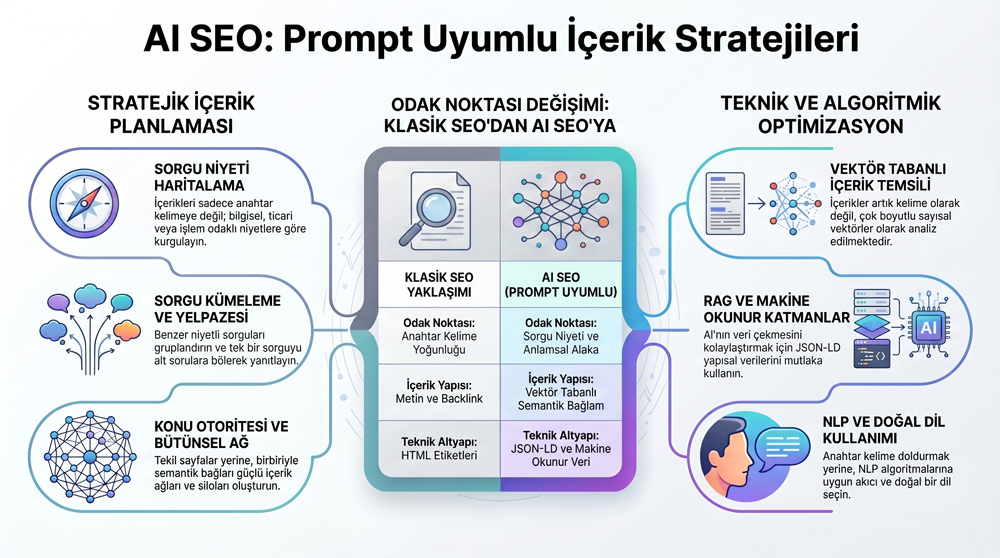
Query Limit Mapping and Enhance Nity Signals
One of the rules that prompt compatible content strategies do not require, classification according to the intention of seeking user queries process. Because artificial intelligence-supported systems look for question intentions first when analyzing the most appropriate content of the user’s search purpose in the corresponding query. For this reason, the content is basically knowledgeable, commercial or transaction-oriented editing. At the same time, the chance of visibility in AI queries is very low, aimed at more than one query intention or intent signals are not strong enough.
The main purpose of prompt compatible content strategies is that the user query is not only on the keyword basis, but correct interpretation of meaningal alaka (semantic relevance). Indeed, these strategies are based on thinking of AI systems "Which asks the question?" in the production of content. AI Search systems are not only giving information, but the most appropriate content to the user’s search purpose. That’s why AI SEO is an important trick to make query intention mapping before working in the context of prompt compatible content strategies.
Before preparing content, you should definitely consider this question: This content will be intended for the purpose of searching? If you think of an informal content, you should build your content in accordance with the knowledgeal calls. In this context, questions such as "What is?", "How?", "Why?" should be answered. If you’re looking for commercial calls, you must follow a strategy for commercial calls. In this context, you should create your content according to concept and qualifications, such as "price", "service price", "best". In AI SEO, you should not forget them within the context of responsive content strategies.
Query Cluster Based Prompt Compatible Content Architecture
Query clustering is one of the basic building blocks of AI SEO content strategies. Indeed, this strategy provides the collection of queries with similar search intentions in the same content pool. For example, "How much is the cost of SEO service?", "How many pounds per month fee forSEO?", queries such as "How much is the service costs ofSEO agencies?" can be considered in the same cluster. Each of these queries is within the scope of commercial calls related to SEO service. You can create such query clusters for your content while developing prompt compatible content strategies in AI SEO.
Here is an important point of tricks, in fact, there is no importance to what words you are using. You should never forget about it. Key word-based content strategies in classic SEO are no longer working in AI-supported systems. Because these systems look at what words in content repeat for a few times, which is more convenient for the purpose of searching the content. It can also be very quickly analyzed whether it is a really valuable content and decide accordingly.
The Query clustering method helps you develop strategies that are compatible with vector embedding method and similarity algorithms in AI Search systems. It also supports subject modeling (topic modeling) processes. AI SEO Strategies Home By creating content silos on your site, you can increase your symmagnetic authority in each cluster. In this way, AI SEO will give more successful results in responsive content strategies. Indeed, this method makes it easier for AI systems to choose more accurately snippet in the sub-document processing phase.
Sub-Query Expansion with Query Yelpazesi Optimization
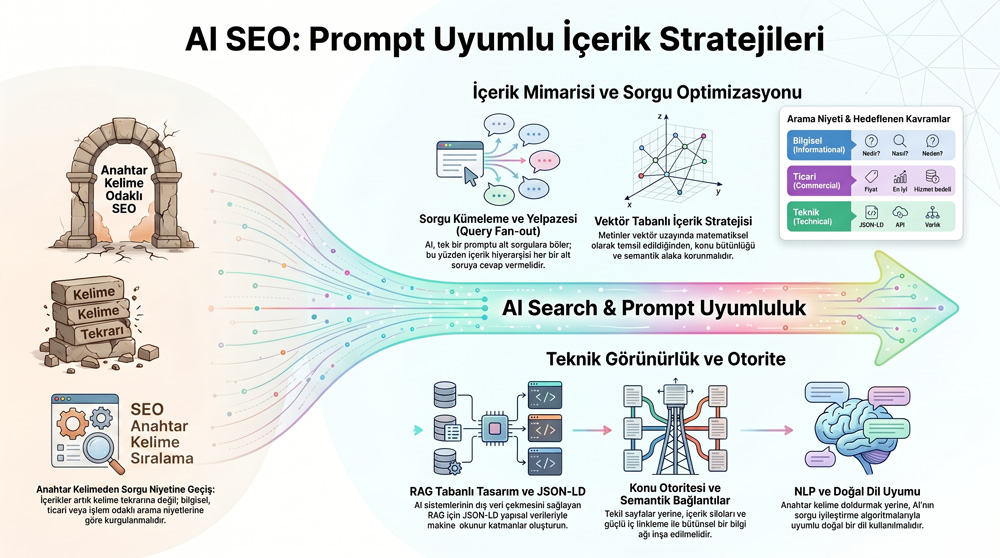
The query range (query fan-out) system is based on the analysis of artificial intelligence-supported search systems prompt-shaped queries by dividing numerous sub- queries. Prompt compatible new generation SEO content strategies should be shaped on multi-layer information parts in this context. For example, a query in the form of "SEO service?", what is the scope of "SEO services in the query fan-out system?", "the companies that provide SEO services" are separated into a large number of sub queries, such as "best SEO agencies".
Your content needs to be responded to different sub- queries to gain more visibility in the query range system. When enriching your content in this context, it is necessary to look at what users do queries about it. A large number of paid or free in this regard SEO analysis You can benefit from the tool. In this way, AI SEO gives prompt-compatible content strategies more successful results.
You should pay attention to the header structure and hierarchy of the content while developing the compatible content strategy. That’s all the header should actually answer a sub query. In this way your content stands out as a stronger reference in sub-document processing processes. In AI SEO, this strategy allows its contents to answer not only the main word, but all sub queries associated with semantic. If you create content by predicting the questions that AI models will produce, not only in a single query, but in many queries, your visibility increases.
RAG Based Content Design and Machine Read Content Layers
RAG-based content design is one of the important factors to stand out in AI-supported search systems. RAG architecture is the architecture that allows AI systems to get information from external data sources before producing answers. Thanks to this architecture, LLMs do not only have to be connected to educational data. RAG systems scan relevant resources and examine data sources. So your content should contain machine readable content layers to stand out as a reference source.
The first and most importantly of machine read content layers is JSON-LD structural data. These data are markings according to assets and characteristics of contents. In this context, asset relations, API endpoints and verification metadata create other content layers. JSON-LD structural data forms the first of machine read content layers in RAG-based content design. How much netse symmagnetic context in content is so strong. API endpoints and verification metadata also make the content stand out in queries.
From this care, you must create strong structural data in JSON-LD format while developing prompt-compatible content strategies in AI SEO. You should use strong semantic links to clarify assets relations in your content. You should also make access to the site and content of artificial intelligence-supported systems. How easy your content can be accessed by RAG systems AI-supported search queries The higher the chances of reference for. You can get beautiful results with structural data and semantic information layers in the new generation of information architecture.
Prompt Compatibility with query improvement optimization
AI systems work to make uncertain or missing user queries more clear. When doing this, they examine the question, separate it into pieces and compare them with similar queries. That’s why your content has a good planning based on sub queries and similar calls. In this way, the chances of display in AI channels increases. Thus, a content planning linked to users’ actual search queries rather than articles full of keywords is critical in this regard. In the context of prompt compatible content strategies in AI SEO, you should never forget this point.
AI systems make query more contextual using NLP algorithms in RAG modeling. The reference value of the content in contextual queries if the natural language usage in content is strong. Based on the use of natural language, NLP algorithms see content filled with keywords without value for users. It evaluates that the use of wrong and extreme keywords does not contain appropriate results to the search purpose. The responsive content strategies in AI SEO are successful in this context but with natural language usage.
From this care, you must necessarily make query improvement optimization in your content, clean uninterested or unnecessary keywords. Another key point at this point is query proposal optimization. The question proposal system is the automatic recommendation system that users encounter during the search. Google AI Mode system and other LLMs often benefit from this system. AI SEO is useful to take into account when developing content strategies. For this, you should keep sympathetic connections strong in the silos that are both content and belong.
For example, let’s say you have a content on "AI SEO?". Every detail from subheads to texts and labels must be associated with semantic perspective. Then you should associate this content with other content that is related with a correct content silo strategy. The internal linking strategy you will use is not a single content, but other related content also increases the chance of reference. In the context of prompt-friendly content strategies in AI SEO, you should not forget them.
Vector Based Content Strategy and Optimization Methods
Contents in AI Search systems are represented by numerical data in vector space, not at word level. Each text piece is converted into a multi-dimensional numerical vector by transformer models. These vectors do mathematically analysis and remove what content tells. The user query is actually a question vector by passing through the same embedding model. Then this vector is compared with millions of content vectors in the database.
In this context, within the framework of prompt-friendly content strategies in AI SEO, the point is critical. You must build your content in the right vector area. For this, you should pay attention to criteria such as semantic relationship, density level, context continuity, subject consistency. Your content should be directly related to the asset (entity) which is addressed in every step of the subtitle and subject flow. The opportunity to be accurately represented in vector space of the content as the relationship level is weakened.
Content planning creates weak, subject flow messy texts, weak representations in vector space. As we move away from the main subject, it is difficult to create meaningful relationships in vector space. So, the content that addresses a clear topic creates stronger topic clusters in vector space. In the context of prompt-friendly content strategies in AI SEO, you should not forget them. Is it strong enough to focus and relationships in your content? If you are strong, your visibility will increase in AI-supported search systems. AI SEO optimization works Thus, it will give more efficient results.
Establish Subject Authority and Increase Visibility
The subject authority allows the site to be "reliable information source" in the AI-supported systems. These systems evaluate not only to single content, but looking at all of their content clusters. The performance of each page gives meaning with other content connected. So the subject authority consists of a total effect of content networks associated with each other, rather than a single strong article.
It is not enough to inform the content only to improve the subject authority. It is also necessary to create information continuity. Every new content is logical and symmetrically strong bonded with previous contents. In this way, information gaps should be completed and their contents are expanded with new connections. Thus, AI systems detect the site as a holistic information network instead of single pages. This increases the level of success in AI SEO-friendly content strategies.
The depth of content in relation to the subject authority is also an important other factor. In this context, instead of superficial explanations, it is necessary to create multi-layer contents that address different sizes of the topic. Indeed these layers increase the subject authority with definition, process, usage areas, comparisons and advanced level analysis. Specifically Google AI Mode User behaviours changing with Turkey activation made content depth much more important. With such improvements, AI SEO’s prompt-compatible content strategies produce more successful results in holistic terms.
On the other hand, content update and consistency are also important in the increase of the subject authority. The content that regularly updated and protects the integrity of the topic produces a stronger authority signal over time. This signal directly affects and increases visibility of AI algorithms. It’s useful to take into account when preparing prompt-compatible content for AI systems.